

An interlude: posts about the psychology of reason, argument and persuasion will resume shortly.
They tell you swearing is an art, but I think it is more of a currency.
Let your potty mouth mint too much sweary-coin and you get devaluation. Now each individual swear buys you less impact on your audience than before. Best to limit the supply of swears, using them only when really needed.
Academic writing is a low profanity environment, and maybe that is why when a scholar swears they may get more bang for their buck than elsewhere. As evidence, I have collected three triumphant examples of scholarly profanity, pieces of writing with a swear word in the title which fill an important gap in our conceptual universe, not despite but perhaps because of their use of cursing.
Without further ado I present:
#1 Fuck Nuance
Healy, K. (2017). Fuck nuance. Sociological theory, 35(2), 118-127. https://doi.org/10.1177/0735275117709046.
The abstract as published in the journal Sociological Theory is:
Nuance is not a virtue of good sociological theory. Although often demanded and superficially attractive, nuance inhibits the abstraction on which good theory depends. I describe three “nuance traps” common in sociology and show why they should be avoided on grounds of principle, aesthetics, and strategy. The argument is made without prejudice to the substantive heterogeneity of the discipline.
But I prefer the abstract from the preprint version, which you can still find here:
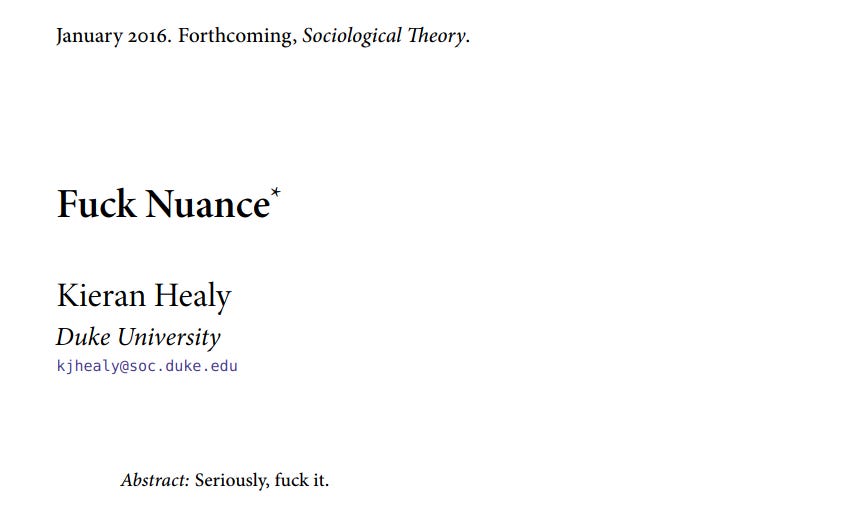
Scholars of theory development will recognise this as a comment in the tradition of Murray Davis’s ‘That’s interesting! Towards a phenomenology of sociology and a sociology of phenomenology’ (1971), in which he discusses different general strategies for producing new intellectual work. One strategy is “Everything you thought was different is actually the same” - where you propose a unifying account of disparate phenomenon. Another is “Things you thought were the same are actually different” - where you show that some unity fails to adequately capture variety within the same supposed phenomenon. Healy’s nuance traps are degenerate versions of this second strategy, and constantly tempting ones.
The theoretical risk isn’t just borne in sociology. I used to work with computational neuroscientists a lot, and it was clear there that there was a constant push to add biological detail to computational models. After all, who could object to making models more realistic? The problem is that you can proliferate complexity endlessly this way, all the while gaining nothing in explanation and abdicating your responsibility to articulate a strategy about why you are adding these details in particular. Soon you end up with verisimilitude to surface details, and nothing understood of function (the left side of this picture):

(More on this in RP#10 Reason to trust models)
Good theories balance nuance and generality. In a knowledge economy where it is hard to criticise constantly adding nuance Healy (2017) provides the necessary counter-weight: fuck nuance.
#2 On Bullshit
Frankfurt, H. G. (2009). On bullshit. Princeton University Press.
One of the most salient features of our culture is that there is so much bullshit. Everyone knows this. Each of us contributes his share. But we tend to take the situation for granted. Most people are rather confident of their ability to recognize bullshit and to avoid being taken in by it. So the phenomenon has not aroused much deliberate concern, or attracted much sustained inquiry. In consequence, we have no clear understanding of what bullshit is, why there is so much of it, or what functions it serves. And we lack a conscientiously developed appreciation of what it means to us. In other words, we have no theory. I propose to begin the development of a theoretical understanding of bullshit, mainly by providing some tentative and exploratory philosophical analysis. I shall not consider the rhetorical uses and misuses of bullshit. My aim is simply to give a rough account of what bullshit is and how it differs from what it is not
In Frankfurt’s analysis bullshit is speech intended to persuade without regard for the truth. Liars know the difference between true and false. Bullshitters don’t know or don’t care, they generate words according to what sounds good, what the audience wants to hear or what the circumstances seem to demand.
Frankfurt’s essay (then book) spawned a slew of responses in his home discipline of philosophy and the book was a hit with a general audience. At the time (essay 1986, book 2005) the concept seemed painfully accurate for describing some politicians. Now it seems painfully accurate for describing large language models. Either way, the problems of speech without regard for truth, and the pollution this causes in our information waters needed naming. That name also provides the ideal response, something you can call out loud whenever someone tries to pull it on you: bullshit!
#3 Enshittification
Cory Doctorow. How monopoly enshittified Amazon. 28 Nov 2022 https://pluralistic.net/2022/11/28/enshittification/
Cory is not an academic, but a writer and scholar of the internet. Enshittification has a profile in the Financial Times, a wikipedia page (featuring all your favourite online platforms) and was word of the year 2023 for the American Dialect Society. The success of the idea is because, in the act of naming the term, it draws our attention to something, something which we feel immediately to be true:
Here is how platforms die: first, they are good to their users; then they abuse their users to make things better for their business customers; finally, they abuse those business customers to claw back all the value for themselves. Then, they die. I call this enshittification
Doctorow’s analysis of enshittification emerges from his deep schooling in Marxist theory, which he draws into a lifetime of experience with understanding online platforms. Just as capital and labour are in conflict over the capture of surplus value,. so users, platforms and businesses are in conflict. Early on, easy money (venture capital) allows platforms to treat users well in order for them to grow, but eventually - when the users are there, and the more locked in the better - the platform can give users a worse experience in order to service their true customers (advertisers or whatever). When they too are locked in, the platform can squeeze everyone in an algorithmic death-spiral which leaves us all tolerating worse and worse until the frog is finally boiled.
In other news: the peristaltic forewarning of enshittification for substack has begun.
There may be others, but these ones are mine
Are there other examples of fantastic swearing in the scholarly literature? I don’t know of any as influential and as necessary as these three, but I’d be happy to hear about others. Maybe we could start our own journal: The Annals of Scholarly Profanity.
Or would that be a fucking stupid idea?
Below, some quick links to things I’ve been reading/noticing/listening to. Thanks for reading my increasingly sporadic posts. If today’s newsletter isn’t what you signed up for, please stay tuned for more on topic posts shortly.
Misinformation Research cancelled in the US
An ex-NSF director on the cancelling of grants relating to misinformation (read the whole thread)
Podcast: Philosophize This!
Episode #207 ... Fear is toxic to a democracy. (Martha Nussbaum)
“But this TENDENCY Martha Nussbaum says, to FEAR our political opponents and turn them into the people that are DESTROYING OUR DEMOCRACY…IS ironically the very type of attitude…that is destroying democracy’s ability to function. “
What we need is less demonisation, and better dialogue folks.
On writing and Education
Daisy Christodoulou puts it well in What is the point of learning to write in a world with AI?
The difference between ancient Greek marathon runners and today's marathon runners is at the heart of so much confusion about AI and its role in society and education.
Students are baffled by teachers who want them to deliver a message via a marathon run when you could just send a text message.
Teachers are baffled by students who want to get a taxi round a marathon course and expect a medal at the end of it.
And finally…
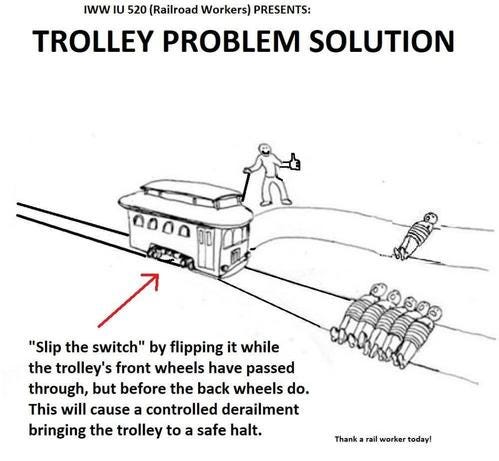
via @kaiarzheimer who posts academic memes daily:
END
Comments? Feedback? Swears? I am tom@idiolect.org.uk and on Mastodon at @tomstafford@mastodon.online
Blooming marvellous article - thank you!
David Graeber’s “On the Phenomenon of Bullshit Jobs” seems relevant though it was published in Strike!, not a scholarly journal