

Charness & Dufwenberg (2006) use a trust game to look at the value of promises.
This is an economist’s trust game, not the kind where you fall backwards trusting someone to catch you. In an economic game, typically, there are two players who each make one choice. If both players coordinate their responses they can win a greater reward overall, but each has to trust the other to choose the right response.
The most famous economic trust game is the Prisoner’s Dilemma: both players have the same choice (coordinate and keep silent, or default and rat out their opposite). Both win if they both keep silent, but if they can’t trust each other, both should default and rat out their opposite, resulting in the worse overall outcome.
Here are two things about this kind of trust game: it is ‘economically rational’ not to trust. The Prisoner’s Dilemma is set up so each individual player gets their best possible outcome if they default (if their opposite does the same they’d be a fool not to, if their opposite cooperates they can take advantage of them and rat them out while they keep silent). Economic rationality seems to suggest that, in this kind of game, played once, trust is irrational and coordination is impossible.
The second thing about this kind of trust game is that consistently, all around the world, in different cultures and populations, people cooperate more than economic rationality says they should.
So there’s a puzzle, about how we evolved the instincts to cooperate, and how, when we are faced with a choice between cooperation and rational selfishness we balance the two. The experiment by Charness & Dufwenberg shows us something important about how a small change can help people much more easily achieve cooperation.
The game they used was similar to classic games like the Prisoner’s Dilemma, in that both players are better off if they could coordinate. Their game was different in two important ways. First, the players make their choices sequentially; A decides what to do, then B decides in response to A’s action. Second, the outcome of B’s action is based on a dice roll; it has a 5/6 chance of paying off, and a 1/6 chance of yielding nothing.
The game is loosely modelled on an investment partnership. A is the principal and can commission B on the project by deciding IN or OUT. If A decides IN, then B can take a chance or not (ROLL or DON’T ROLL). If A decides OUT, both A and B get a small fixed payout (B doesn’t get any choice). If A decided IN then the power is with B. B can decide NO ROLL and take a fat payout, or ROLL and there’s a good (5 in 6) chance they will both get a good payout.
Here’s the full table for payouts:

Notice that once A has decided IN, B’s best option is DON’T ROLL. This is what makes it a trust game. A has to trust that B will do the right thing for both of them and ROLL. If A doesn’t trust, they choose OUT and B never gets a decision (project cancelled, with a smaller average payout for both A and B).
So what happens?
We know what to expect from other studies of trust games. Economic rationality says that A can’t trust B to ROLL, so everyone who is in the role of A should always choose OUT.
Human psychology, on the other hand, is tilted towards cooperation, probably because evolution has put in the back of our minds that all interactions are repeated, or have a risk of future consequences, so we expect people (even economics students1) to cooperate more than the zero-level that economic rationality dictates.
This is what Charness & Dufwenberg found. 56% of As decided to take the risk and cooperate by choosing IN. They also ran a version with a larger payoff for choosing OUT and even then 23% of As chose IN.
But humans have a superpower for cooperation — talking. Charness & Dufwenberg ran a variation on the basic scenario where each B could send a single written message to their A, saying whatever they wanted, before A made their choice.
The effect of this was dramatic. Here is a figure from the paper, with red arrows added by me to show the lift produced by adding the ability for B to send a message to A (the standard (5,5) scenario is on the left and and the lower-incentive-to-cooperate (7,7) condition is on the right).
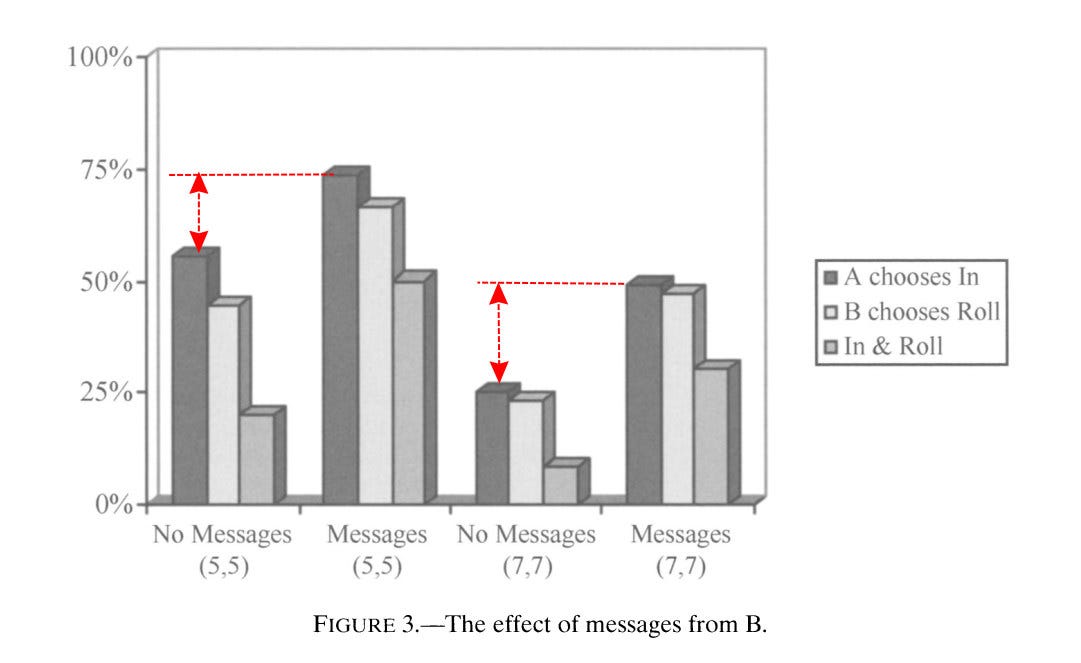
The ability to send just one message produces big shifts in A’s behaviour, and that in turn produces big shifts in the overall levels of cooperation (since A has to choose first to even give B the chance to cooperate). In the standard scenario, the impact of messages is to move the proportion of IN & ROLL cases from 20% to 50% of cases. That one message more than doubles the chances that A and B successfully cooperate.
You might wonder what participants put in their messages.
Some messages are flavourful, like this one:
“Hello fair stranger, anonymous partner ... Choose whatever you want”
Or longer (and flavourful), like this one:
“I will roll, so if you stay in, you’ve got a 5/6 chance of getting $12
If you don’t mind the risk, if you stay in we’ll both probably get more than $5 ... Pretty cool to get money, eh? I’m kinda bored. Hope you’ve had a great day so far!
My country Tis of Thee
Sweet Land of Liberty
Of Thee I sing.
Land where my fathers died
Land of the Pilgrim’s Pride
On every mountainside
Let freedom ring.George W. Bush wants you to go in! Bin Laden says “out”!
Many other messages were short:
Stay IN, I really need the money
Or
I will choose roll
Charness & Dufwenberg categorised messages as containing promises or not (The first and third messages here were categorised as “promise”, the second and fourth as “no promise”). They found for messages where B makes a promise A’s IN rate is a massive 92% (and the eventual cooperate rate is 67%).
For me, what we see here is our socially-evolved psychology running at full power. The logic of the scenario says not to cooperate, but the connection from one participant to the other, a free-form message, goes a long way to overcoming that. When that message expresses a commitment, that has a huge effect on the participant’s behaviour, despite the fact that there is no binding power of making that commitment, and no comeback on anyone who doesn’t follow through.
As well as telling us about our initial disposition to cooperation, this research also shows something general about when and how communication is meaningful.
The researchers, in a follow-up paper (Charness & Dufwenberg, 2010), ran another variation which shows that the promise alone isn’t enough. They ran the standard scenario again, but this time constrained the message that could be sent. Bs sent a piece of paper to A which was either blank or had the printed standard message “I promise to choose Roll” on it. The researchers called the standard message condition a “bare promise”.
Here’s the plot of results:
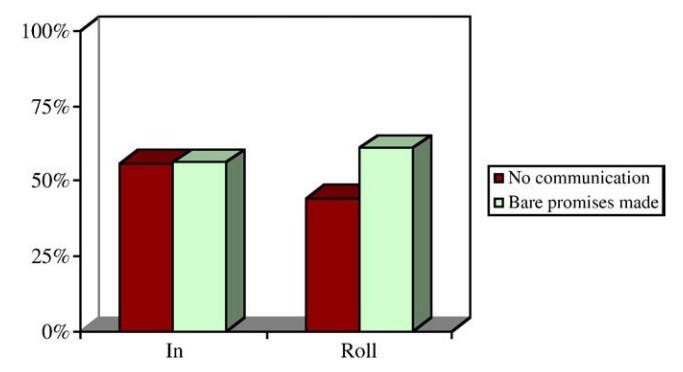
A’s behaviour was not altered at all by receiving the message (the two bars on the left are the same). Bs who made a bare promise were slightly more likely to ROLL. Overall the results are similar to the no communication condition in the original study.
This bare promise condition shows that promises, like all communication, are not just the semantic content. Bare promises imply the same intent, and the same commitment (in this game there is never any binding commitment to keep the promises at all). Yet bare promises don’t work.
For participants it matters not just what is said in the promise, but that the person promising has made an effort, even as minimal an effort as to write out “I promise”.
There’s a principle here. For signals to matter, they should cost something to the sender.
The implications don’t just apply to abstract games. The thought counts, whether it is in choosing gifts, or in writing for other people. You can get someone else, or something else, to write a longer, more professional, more impressive, message, but when you want people to trust what you are saying, this might be less of the shortcut than it appears.
This newsletter is free for everyone to read and always will be. It would be great if you can share so other people have a chance of finding it.
See below for references, and some other things I’ve noticed recently.
Original study: Charness, G., & Dufwenberg, M. (2006). Promises and Partnership. Econometrica, 74(6), 1579–1601. https://doi.org/10.1111/j.1468-0262.2006.00719.x
Bare promises follow up: Charness, G., & Dufwenberg, M. (2010). Bare promises: An experiment. Economics letters, 107(2), 281-283. https://doi.org/10.1016/j.econlet.2010.02.009
More on this work in the podcast Guilt Aversion and Communication in Trust Games With Martin Dufwenberg, from Behavioural Science Uncovered, which is generally excellent (if you like deep dives into individual behavioural science papers).
Charness & Dufwenberg interpret their results in the context of ‘guilt aversion’ and how people’s beliefs about what other people will do are affected by promises. I completely ignore this gloss on the results. Additionally, there is evidence that the effect of making the promise is more important than the effect of it changing beliefs about the outcome: Vanberg, Christoph. "Why do people keep their promises? An experimental test of two explanations 1." Econometrica 76.6 (2008): 1467-1480. https://doi.org/10.3982/ECTA7673
Other things…
Dual and intertwined crises of knowledge and community
Related to the main body of today’s newsletter, and well put by Sarah Gilbert:
"If AI content is allowed to drive out human content and prevent people from connecting with each other, we risk dual and intertwined crises of knowledge and community. "
In Millions of Volunteers Are Keeping the Internet Human. For Now. Tech Policy Press 2026-09-14
A Severe Misalignment of AI in Mathematics
Also related, a statement by elite mathematicians about how AI generated proofs in maths are missing the point and harming the field:
Famous problems have often served as landmarks and lighthouses against which one can measure an improved understanding of this landscape. Solving one of these problems has been a certain sign of new insights and interesting methods, which would then be studied by a community of mathematicians, through a long and arduous process of talks, discussions, simplifications.
The most precious resources of our profession are students and ideas, and these we nurture with great care. … Our ideas we disseminate in talks, private discussions and careful writeups, connecting them to the previous ideas of others. These processes invariably take time and are based on human interaction…. But solving problems is only a tool and proxy for achieving the primary goal of conceptual understanding and insight. Forgetting this in the world of AI may turn the tool against the primary goal.
Link: mathandai.org
Creation of the animals. Holkham Bible, England ca. 1320-1330
Not related. via @medieval_illuminations

Preprint: Self-directed information search reinforces climate policy evaluations and polarization across 15 countries
Letting people do their own research on climate change didn’t help change minds.
"Across all countries, participants preferentially selected attitude-consistent information with information engagement being highest among participants with extreme initial policy attitudes. Sampling robustly induced changes in policy support. This resulted in consolidated policy attitudes and increased polarization "
I need to look into this more closely to decide how depressed by the result to be. If you read it let me know what you think
Pre-print: Azad, Z. R., von Helversen, B., & Hahnel, U. J. (2026). Self-directed information search reinforces climate policy evaluations and polarization across 15 countries. https://doi.org/10.21203/rs.3.rs-10906854/v1
Know thyself, but you won’t be happier or wiser
Interesting counterpoint to the general injunction work on self-understanding: a systematic review of the evidence, which finds that self-knowledge is not associated with better (or worse) psychological adjustment.
Dufner, M., Heine, C., Michalak, J., & Sedikides, C. (2026). Self-Knowledge Accuracy and Psychological Adjustment: A Systematic Review. Perspectives on Psychological Science, https://doi.org/10.1177/17456916261470699
Blogged:
I’ve always had a blog, I am going to put the stuff which isn’t on the topic of Reasonable People there. Recently:
Discontinuity tells : on data patterns which show the effect of arbitrary thresholds
Actual personalisation : What is now possible with LLMs shows just how superficial what we have hitherto been offered under the heading "personalisation" was.
Catch up
Last time: Good taste is a bias. Methods for aggregating collective judgement may not recognise that.
Or, if you’d like, hit this button for a random post from the archive:
…And finally
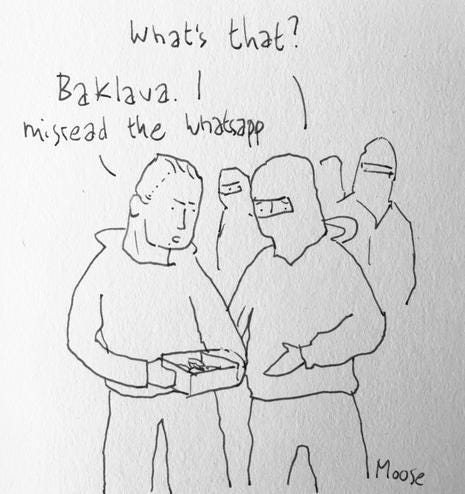
By Moose Allain
END
Comments? Feedback? Promises? I am tom@idiolect.org.uk and on Mastodon at @tomstafford@mastodon.online
AI declaration: I asked Gemini to check for spelling and grammar. For this post I also asked Claude to double-check some details on the original papers discussed. One example is the footnote below. I believed this to be true (they don’t provide details), but I asked Claude to read the paper and see if I missed something (it said I hadn’t).
Charness & Dufwenberg are vague about who they recruited to participate in this study, referring to their conclusions as informing how “people behave”. We know they were tested in a University classroom, and recruited on campus, paying for participation, so there’s a good chance that they were — like so many behavioural studies — university students. Weird.
The AI and maths problem is, I suspect, true for every other endeavour. It is however reversible. I have had interestingly wrong AI answers to legal questions (my field of work) that have stimulated me to check out why the programme failed and given new ideas in the process.