

There is a long history of studying the conditions under which groups make good decisions. Contrary to the popular idea that groups invariably swing towards the loudest voices, or polarise, or race to the floor of the simplest, stupidest idea, there are many studies which show that groups can make better decisions than individuals, and that deliberation - the exchange of arguments - helps with this.
A study from nearly two decades ago demonstrates this with an interesting intervention - alcohol, something which is well known to increase the, shall we say, variability of individual judgements.
Back in 2008, Daniel Frings and colleagues from the University of Kent published a report showing that the decision-making benefit of being in a group increased when the individuals in that group were slightly drunk.
What they did
Recruiting university students (of course), the researchers asked participants to listen to a short recording of a 300-word passage about Russian history and count the number of times the word “the” was used. Sixty-six participants took part on their own, and 210 in 55 four-person same-sex groups (“single-sex groups were selected to avoid possible confounds arising from cross-gender interactions” report Frings et al. )1
Individuals provided their count estimate, then - if in a group - discussed it and decided on a group consensus.
Half of participants were in the alcohol condition, and half in a placebo condition. The alcohol participants were given enough orange juice and vodka to put them around the drink-driving limit (mean Blood Alcohol Concentration for these participants was 0.06%). The placebo group were given orange juice and tonic with 2ml vodka floated on the surface (enough to disguise that they weren’t in the alcohol condition, but not enough to get them drunk).
Here are the results:
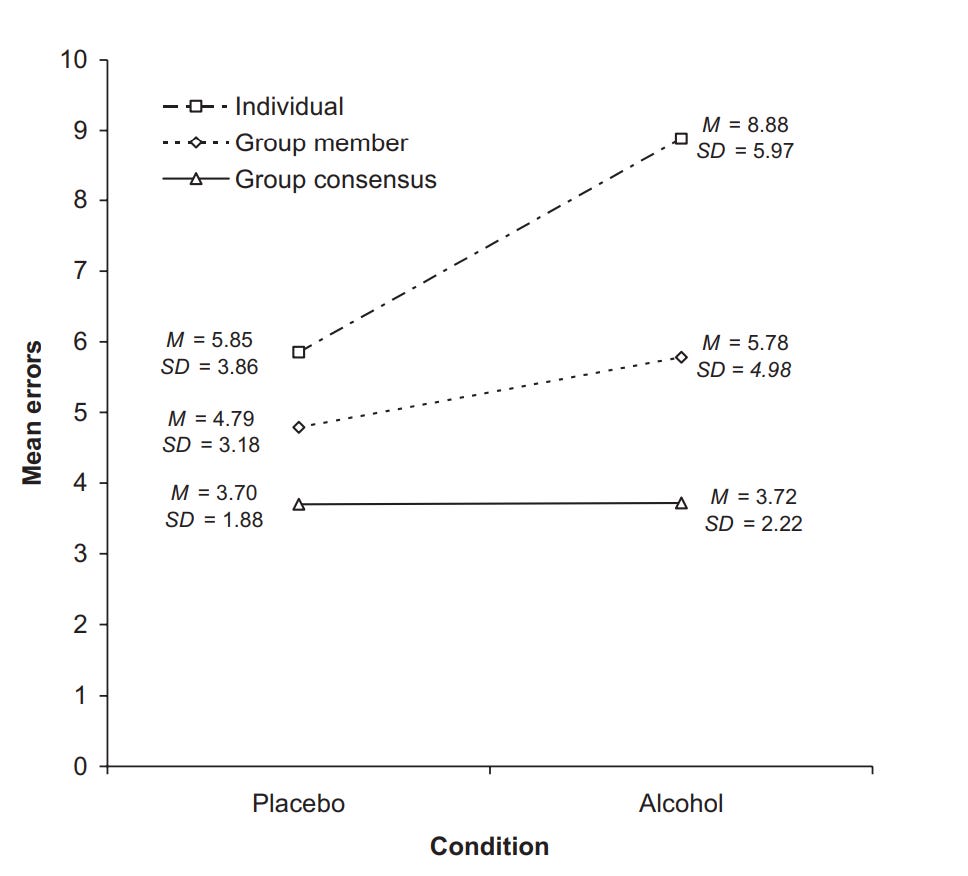
The vertical y-axis shows the error - the distance from the true count of 20 “the”s in the passage (so higher up is worse performance). The placebo group show a group decision-making advantage: the group consensus was better than the individual judgements of those who listened on their own, or those who listened in a group and made a private judgement before the discussion (interestingly there is an advantage to listening in a group versus alone: possibly being in a group made people concentrate harder even before they got to discussing).
The alcohol made the individual judgements worse (you can see the upward slope of the top line showing that individuals made on average 50% more errors). But the alcohol-intoxicated groups (bottom right) produced just as good consensus answers as the sober groups (the bottom line is flat).
A theory of group think
The result fits with a number of accounts of how groups can help decision-making. First off, groups have more individual estimates to draw on, so there’s a “wisdom of crowds” effect to be had by just averaging each individual’s answer. The theory being that each individual judgement approaches the truth, but with some error. Average across many individuals and you average out the error, converging on the true value. If this is what is happening you would predict a group of more errorful (i.e. drunk) individuals could still perform well. As long as they are equally likely to overcount and undercount, it doesn’t matter if they are more unreliable. Averaging still converges on the true value. It is precisely under conditions where you have more uncertain individual judgements that you can best see the advantage of having a group to average across.
But the groups in Frings et al’s experiment weren’t just providing judgements to be averaged across, they discussed their answers and arrived at a consensus. By comparing this consensus to the average of individuals’ answers the researchers tried to gain some insight into what the group was doing. They concluded that the “just average over everyone” account applied less well when the group was drunk - instead what was happening was that the group arrived at a consensus by looking across all the individual answers and discarding the most extreme outliers - exactly the outliers which led some individuals to raise the average error when they didn’t have the group to monitor them.
In the words of a follow up study, “groups may provide an informal means of mutual regulation and monitoring that can offset some aspects of alcohol myopia”. Put another way, when alcohol creates the risk that decision-making may go off the rails, group decision-making provides a protective function, as group members calibrate their judgements against each other. Although it may be fanciful, we could describe the group as providing an “overbrain” for individual cognition, a protective layer of monitoring and reflection that - much like the self-monitoring and reflection that each of us does at an individual level (and which is impaired by alcohol intoxication) - protects us from some of the worse mistakes we might make.
Rigour check
This study is from the glory days of attention-seeking and unreliable research in psychology (1990 - 2015?), so despite the robustness of the method (a true experiment, with appropriate controls), and the clarity of the write-up, I still have a low prior belief on this result being reproducible. The signs of credibility I normally look for (a preregistered analysis plan, open data) weren’t established as normal at this point, so I can’t fault the researchers for not including these, but without these (without even uncertainty estimates on their graph points!) it is hard to judge how confident to be in their results.
The thing I like about the study is that it uses an intervention - booze - which we know to increase individual error and uses this to test the effect of the group on decision-making. I will wait until someone replicates the finding before placing 100% faith in the effect, but it fits with what else we know about potential benefits of groups on decision-making.
Frings, D., Hopthrow, T., Abrams, D., Hulbert, L., & Gutierrez, R. (2008). Groupdrink: The effects of alcohol and group process on vigilance errors. Group Dynamics: Theory, Research, and Practice, 12(3), 179.
This newsletter is free for everyone to read and always will be. To support my writing you can upgrade to a paid subscription (more on why here)
Keep reading for further reading on trade-offs in decision-making, social media and understanding the far right
CATCH-UP
Recently from me:
Faking survey responses with LLMs Survey research is a key mechanism by which society knows itself, we should all be worried if can’t be trusted.
When less (communication) is more (collective intelligence): Team work, complex problems, and preserving diversity in the ecosystem of ideas
Listening to Tommy Robinson: What did I learn by giving the right-wing activist my ears for 90 minutes?
Helping people spot misinformation: And the greatest gift psychology gave the world
The Ideological Turing Test: Do you truly understand those you disagree with?
Community Notes require a Community: How we used a novel analysis to understand what causes people to quit the widely adopted content-moderation system
Dan Williams: Is Social Media Destroying Democracy—Or Giving It To Us Good And Hard?
Dan Williams argues against the popular notion that untamed social media is deranging the populace. Rather, he says, it has unleashed the mess of beliefs that the population normally hold, uncapped by elite consensus on what is permissible.
When the kinds of people who write think pieces about how we’re living through an era of conspiracy theories encounter such ideas on social media, they assume that the platforms created them. But in reality, they’re simply being exposed to popular ideas that their bubble and preferred media outlets previously shielded them from.
The argument is that social media is an essentially democratising force, for good and bad. Williams deploys one of my favourite quotes : “Democracy is the theory that the common people know what they want, and deserve to get it good and hard.”
The question for me is, if the era of elite gatekeeping is over, what are the alternatives to keep public discourse healthy? My hunch is that the problem of the democratic market for ideas can only be solved by measures which are themselves democratic, and probably a large part of this will be in the realm of norms. We need taking ordinary measures against falsehoods and lies to become as normal as washing your hands against biological illness.
Link: Dan Williams: Is Social Media Destroying Democracy—Or Giving It To Us Good And Hard?
The Atlantic: Elon Musk’s Worthless, Poisoned Hall of Mirrors
Article on what happened this week when X/Twitter launched an “About this account” feature, showing details of how, and where from, individual accounts are managed. In summary:
Almost immediately, “About This Account” stated that many prominent and prolific pro-MAGA accounts, which signaled that they were run by “patriotic” Americans, were based in countries such as Nigeria, Russia, India, and Thailand. @MAGANationX, an account with almost 400,000 followers and whose bio says it is a “Patriot Voice for We The People,” is based in “Eastern Europe (Non-EU),” according to the feature, and has changed its username five times since the account was made, last year. On X and Bluesky, users dredged up countless examples of fake or misleading rage-baiting accounts posting aggressive culture-war takes to large audiences.
Link: Elon Musk’s Worthless, Poisoned Hall of Mirrors
PODCAST: Jemima Kelly’s Adventures With The Radical Right
Ian Leslie talks to Jemima Kelly about going to a garden party with alt/young/radical right influencer Curtis Yarvin. A nice complement to my post on listening to Tommy Robinson - just where are these people coming from? There’s a weird blend of Very Online meme-referencing (which seem antithetical to actually taking anything seriously) and a genuinely earnest seeking after values and meaning (on which, Mana Afsari’s piece from January 2025 is very good Last Boys at the Beginning of History)
Link: Jemima Kelly’s Adventures With The Radical Right
Koenfucius: (Well) beyond the trade-off
Trade-offs are inherent to many models of decision-making, especially utility maximising accounts popular in economics. Koenfucius argues that it isn’t so simple - many decisions are determined by construing them in a particular way, adopting a perspective or a rule that means that an explicit trade-off either isn’t made or isn’t relevant. Decisions making is often really about conflicts between different construals, not trade offs, he says:
In the end, we are not calculators, adding and subtracting the relative utility of options, but negotiators in the deeply human struggle between complex contradictory interests.
Link: (Well) beyond the trade-off
…And finally
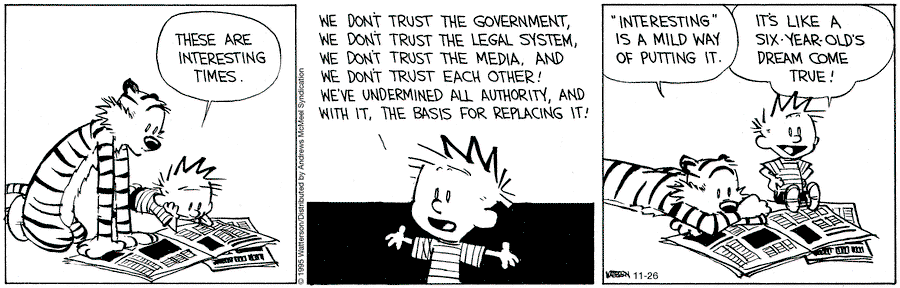
Calvin and Hobbes, by Bill Watterson, originally from November 29, 1995
END
Comments? Feedback? Buy me a drink? I am tom@idiolect.org.uk and on Mastodon at @tomstafford@mastodon.online
“Possible confounds arising from cross-gender interactions” is my new favourite euphemism