
Social thinking
How other people, even if just imagined, can help puncture the illusion of understanding

It’s embarrassing to realise mid-sentence that you don’t understand what you’re talking about.
If you have any self-awareness, I’m sure you can recall a time it has happened to you. If you have better luck than me then it hasn’t been at the point you stood up to teach a class.
The illusion of explanatory depth is where you have a feeling of familiarity with a topic, which prevents you realising the extent of your ignorance. You can recognise a car engine, the human eye, or the government’s fiscal stimulus policy. You can even have enjoyable conversations about them, but that is a very different thing from understanding how they work.
The illusion has a surprising strength. It is strong enough to last right up to the point we are forced to explain our understanding out loud (and for some of us, even beyond that). Probably the illusion exists for a reason. It protects us from fresh interrogation of everything we think we know, allowing us to think with concepts, rather than about them. Navigating rush hour would be much harder work if you had to think about the fundamental nature of your understanding of car mechanics at the same time.
The artificial circumstance of teaching is almost guaranteed to snap you out of the illusion that you understand something when you don’t. Hopefully this happens before the class starts, as you put yourself in the place of a student who will learn about something for the first time and imagine how you are going to help them understand it.
Sometimes just the planning and anticipation of teaching is enough for me to realise I don’t fully understand something.
Sometimes, though, even knowing I need to explain something and planning to explain it still doesn’t shake loose the presumption that I understand it. A basic law of thought is that we tend to preserve energy by not thinking when we don’t have to — we are cognitive misers, hence our reliance on habit and other shortcuts. This is brought home to me when my illusion of understanding is preserved right up until I am forced to put an explanation into words. Only at that point does the file I’ve mentally (and miserly) labelled “explanation here” evaporate into nothing.
When I put something into words, whether in inner speech, or by writing it out, it converts my thinking into an object I can then scrutinise, and so apply the scepticism that needs to be applied to test the quality of an explanation.
Putting thoughts into words in front of other people brings even more self-scrutiny, partly out of self-consciousness, and partly out of a kind of priming of the perspectives of others. When I speak to a particular audience I can’t help but imagine their responses, either from specific individuals I know, or from possible types who may be present (a sceptic from a particular ideological position, for example).
Just imagining that you might be wrong is enough to create demonstrable benefits to problem solving and estimation, which has been variously called “the wisdom of crowds on single player mode” and “dialectical bootstrapping”. I like to think that the imaginary crowd has a similar salutary effect on more complex thoughts. The audience does more than just make me imagine I might be wrong. It invites me to consider, from the diverse perspective of the audience members, the multiple dimensions along which I might be wrong.
Phenomena like these mean that thinking is never really a solitary activity. It is fundamentally social. Even when we are talking to ourselves we are using the socially orientated mechanisms of language to externalise our thoughts and feed them back “into” our minds. Once private thoughts have been forced through the tubes of language they take on an unmissable scent of the outside world.
Finally, there is no substitute for the real world, and in particular discussing an explanation with real people. When this happens I no longer need to simulate critical responses, I get them direct. This is one of the reasons why groups can outperform individuals in various cognitive tasks, as the different individuals bring different knowledge and perspectives to a task and so pool these within the group.
But overt exchange of feedback from others is only one of the reasons groups might enhance problem solving in the members. If, as I’ve argued, just thinking about what other people might say can allow us to root out errors or incompleteness in our thinking, then the mere presence of the group can enhance problem solving. Even without the group actually being present, the mere imagination of the group might also bring a benefit. And even without the group being explicitly imagined, the processes of thinking out loud (or even mentally) are patterned by our evolution as social reasoners.
Every live group discussion will also trigger all the other benefits, just as you can get some of the benefits of a live group discussion through mental simulation. I imagine it like a set of concentric layers: a live group can give actual feedback, but will also vividly prime the existence of alternative perspectives. Imagining alternative perspectives will trigger self-consciousness, and being self-conscious/self-scrutinising will require you to articulate your understanding in language. You can have inner layers without outer layers, but not vice versa:
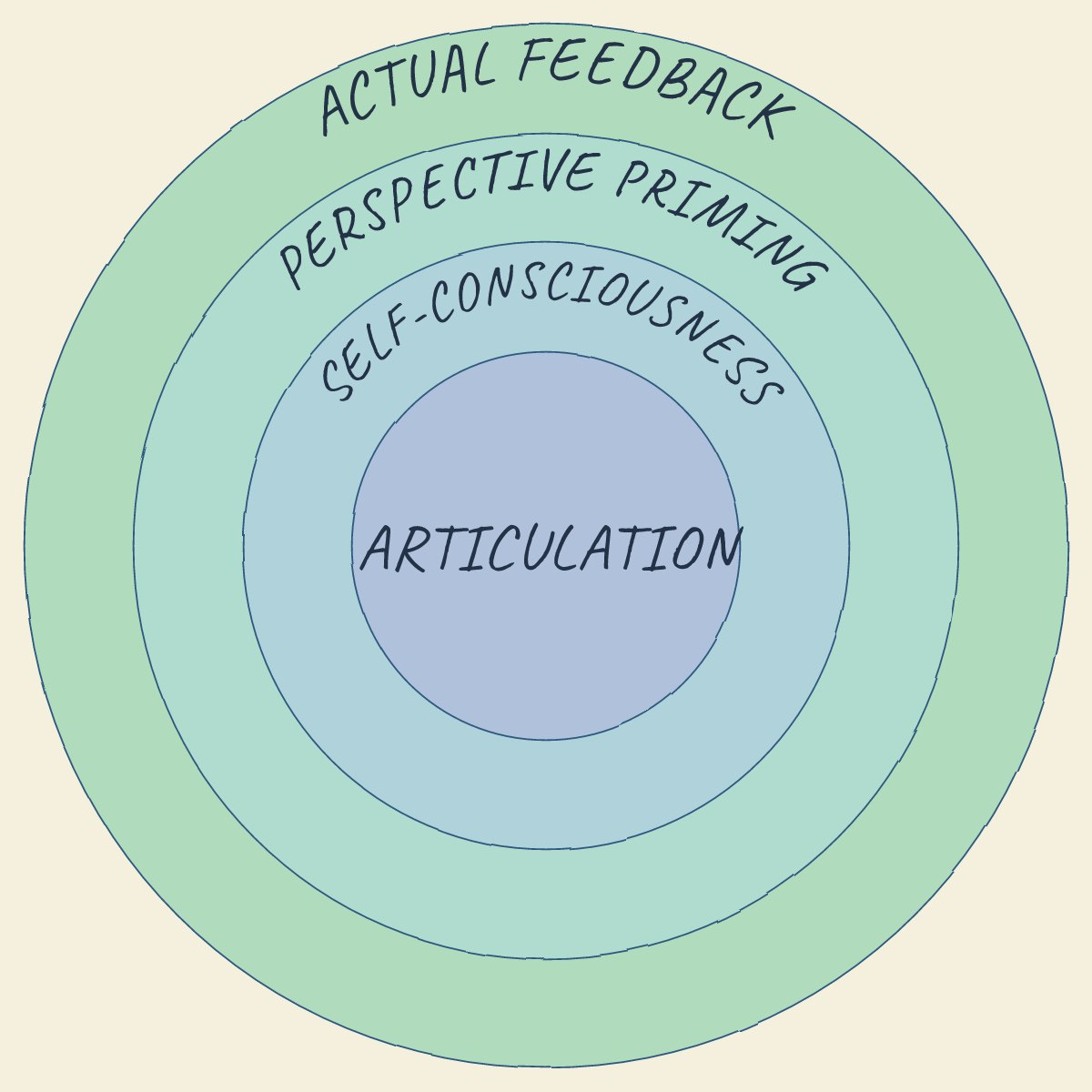
This creates a dilemma for our studies of the benefits of groups for problem solving. Which of these different levels is necessary or sufficient to produce any benefits we see? We can test people on their own, or in groups, but the aggregate effect will be due to a collection of all the different processes triggered by groups.
Only by adding additional, non-group, non-solo, conditions would we be able to discern what it was about groups that brought the cognitive benefit. Something like:
Group 1: Asked to solve a problem
Group 2: Thinks aloud while they solve the problem
Group 3: Thinks aloud, while in front of a group
Group 4: Group discussion
How far you can get just with mental simulation would be the contrast between Group 2 or 3 and group 1. The benefit you can only get from interacting with real people is the contrast between Group 3 and Group 4. Most research on the benefits of group function just compares the full suite (Group 4) against unadorned solo efforts (Group 1), and so probably overestimates the benefit of group discussion per se, failing to account for the power of simulated reflection.
While this elaboration has a moral for psychology research, there is also a practical implication for anyone who wants to straighten out their thoughts and avoid falling for the illusion of explanatory depth. First you need to adopt the discipline of forcing yourself to articulate what you think you understand. Next you need to cultivate your imagination about, and sensitivity to, the different reactions your explanation might provoke. And finally, if you can, you’ll learn a lot by putting your thinking out in front of other people.
I’ve found writing a newsletter is good for all three of these. Thanks for reading!
This newsletter is free for everyone to read and always will be. If you can afford it, feel free to chip in to help me keep writing for everyone: upgrade to a paid subscription (more on why here).
See below for references, and other things I’ve noticed.
References
Rozenblit, L., & Keil, F. (2002). The misunderstood limits of folk science: An illusion of explanatory depth. Cognitive science, 26(5), 521-562. https://doi.org/10.1207/s15516709cog2605_1
Herzog, S. M., & Hertwig, R. (2009). The wisdom of many in one mind: Improving individual judgments with dialectical bootstrapping. Psychological Science, 20(2), 231-237. https://doi.org/10.1111/j.1467-9280.2009.02271.x
Landemore, H. (2017). Democratic reason: Politics, collective intelligence, and the rule of the many. Princeton University Press.
Other things…
Paper: Algorithmic Monocultures in Hiring
If every company uses the same AI tool to screen CVs, it compounds the danger that someone will get wrongly rejected — if they are rejected for one job they are more likely to be rejected from all jobs. It’s a case where there is a second-order risk of AI tools on decision making. No tool will avoid all mistakes, but the current economy means a small number of AI companies dominate, meaning that any mistakes in their tools also dominate.
I take from this that we should design in more diversity in our AI ecosystem.
Page: algorithmichiring.github.io
Bommasani, R., Bana, S. H., Creel, K. A., Jurafsky, D., & Liang, P. (2026, June). Algorithmic monocultures in hiring. In The 2026 ACM Conference on Fairness, Accountability, and Transparency (pp. 6351-6382).
Wealthy warned over HMRC’s use of AI in tax crackdown
“Wealthy individuals are being warned that their tax affairs are more likely than ever to come under scrutiny as HMRC steps up its use of AI and data analytics for intelligence gathering.
The alert comes from advisers after the tax authority this week said that the use of digital analytics and surveillance tools helped bring in or protect about £10bn in tax in the last financial year.”
Seems like not just a Good Thing, but an interesting example of playing to AIs strengths — AI has the bandwidth to allow wider scrutiny, which can then flag individual cases for human review.
Link: Wealthy warned over HMRC’s use of AI in tax crackdown. Financial Times, 2026-07-11
Catch-up
Striking evidence for forced experimentation. A natural experiment shows how we always have something to learn, even about the things we are most familiar with.
Another algorithm is possible. How social media could easily be changed to stop us hating each other so much
AI systems out-persuade expert humans. Panic? Quick review of a compelling new report
Why we like to believe other people are stupid. Reason sells, but who’s buying?
Social Media Is Now Parasocial Media
When practitioners used the term “social media” to describe the internet tools that emerged in the mid-aughts, they were giving a name to the kinds of platforms and protocols that allowed people to socialize with friends and communities of interest by using digital technologies. Twenty years later, users of social media are far more likely to scroll than post – and the content that they consume is often strategically produced and algorithmically curated. In this essay, I argue that the very essence of social media has changed. To more effectively interrogate what we are witnessing, we need to stop presuming that these tools are “social media” and begin recognizing that they are now “parasocial media.” Doing so raises new questions about digitally mediated sociality, not to mention the politics and governance of these platforms.
boyd, d. (2026). Social media is now parasocial media. Social Media+ Society, 12(2), 20563051261437487. https://doi.org/10.1177/20563051261437487
The Empty Chair: Using LLMs to Raise Missing Perspectives in Policy Deliberations
A case study, so doesn’t really prove anything, but it is a nice idea of the sort of thing you could use AI for (not without risk)
In this work, we explore the use of large language model (LLM) personas to introduce missing perspectives in policy deliberations. We develop and evaluate a tool that transcribes conversations in real-time and simulates input from relevant but absent stakeholders. We deploy this tool in a 19-person student citizens’ assembly on campus sustainability. Participants and facilitators found that the tool was useful to spark new discussions and surfaced valuable perspectives they had not previously considered. However, they also raised skepticism about the ability of LLMs to accurately characterize the perspectives of different groups, especially ones that are already underrepresented.
Fulay, S., Dimitrakopoulou, D., & Roy, D. (2025). The Empty Chair: Using LLMs to Raise Missing Perspectives in Policy Deliberations. arXiv preprint arXiv:2503.13812.
…And finally
The 9 purple dots illusion. It’s a static image, 9 blue dots but the one(s) you look at appear(s) purple. A key ingredient is that the centre of your vision is less sensitive to blue light. The diminished sensitivity to blue in the centre shifts the percept towards purple (because purple is a mix of the signals from the red and blue receptors in the eye). Neat.

Paper: Schulz-Hildebrandt, H. (2026). When purple perceived only at fixation: A fixation-and distance-dependent color illusion. Perception, 03010066261423048.
END
Comments? Feedback? What didn’t I understand? I am tom@idiolect.org.uk and on Mastodon at @tomstafford@mastodon.online
AI declaration: I write all the words and think all the thoughts myself. I asked Gemini to check for spelling and grammar. For this post I also asked Claude to make the concentric circles diagram. The version Claude and I produced was much improved by feedback from H. (a human).