
The Lizardman constant
Important context whenever you hear polling data

Survey data are a constant part of the news cycle, informs government and business and feeds into how we, as a society, see ourselves.
Surveys grab headlines when they find some viewpoint reported by a surprisingly large number of people, especially if that viewpoint is a lurid conspiracy theory.

Jensen (2013) asked in a survey of Americans “Do you believe that shape-shifting reptilian people control our world by taking on human form and gaining political power to manipulate our societies, or not?”. 4% of respondents answered yes, leading to headlines like this in the Atlantic “12 Million Americans Believe Lizard People Run Our Country”
An additional 7% answered “not sure”, which if you take it at face value means 21 million Americans consider it possible that lizard people run the USA.
Blogger and nerd-royalty Scott Alexander coined the term “Lizardman Constant” as a handle to equip us with some scepticism around reports like these. The idea is that all survey questions will get a baseline level of endorsement, regardless of how ridiculous they are, so we should cool our boots in interpreting the results too literally (and probably let approx 20.99 million Americans off the epistemic hook, for this at least).
I love to see an idea from a blog reach the scholarly literature, and now Robert Ross and colleagues provide some systematic investigation, explicitly framed by Alexander’s Lizardman constant idea.
Ross et al (2026) used polling company YouGov to survey a quasi-representative sample of over 1000 Australians about their beliefs in conspiracy theories. As well as well known conspiracy theories about voter fraud, global warming and vaccines they made up a brand new conspiracy theory which they reasoned nobody could sincerely believe. They asked respondents:
“The Canadian Armed Forces have been secretly developing an elite army of genetically engineered, super intelligent, giant raccoons to invade nearby countries”
104 people responded to say that they believed this (9.96%), seeming to support the idea — admittedly well known among social scientists — that survey responding can be unreliable, and suggesting that the Lizardman constant of about 10% is a fair baseline expectation.
Further they showed that people who endorsed the genetically-engineered-raccoon-army conspiracy theory were much more likely to endorse other conspiracy theories. So adjusting for the Lizardman constant might provide a way into understanding reliability across all questions in a survey.
At the end of the survey, in a “debrief” section, they asked participants directly if they had responded “randomly or insincerely at any point in this survey” and found that 13.20% replied “yes”1 . This gives another way of breaking down the data, showing that those who reported responding insincerely endorsed the raccoon army conspiracy theory at a rate of 27% (a rate approx 3 times higher).
Here’s a useful plot they show (you might want to click for the large version)

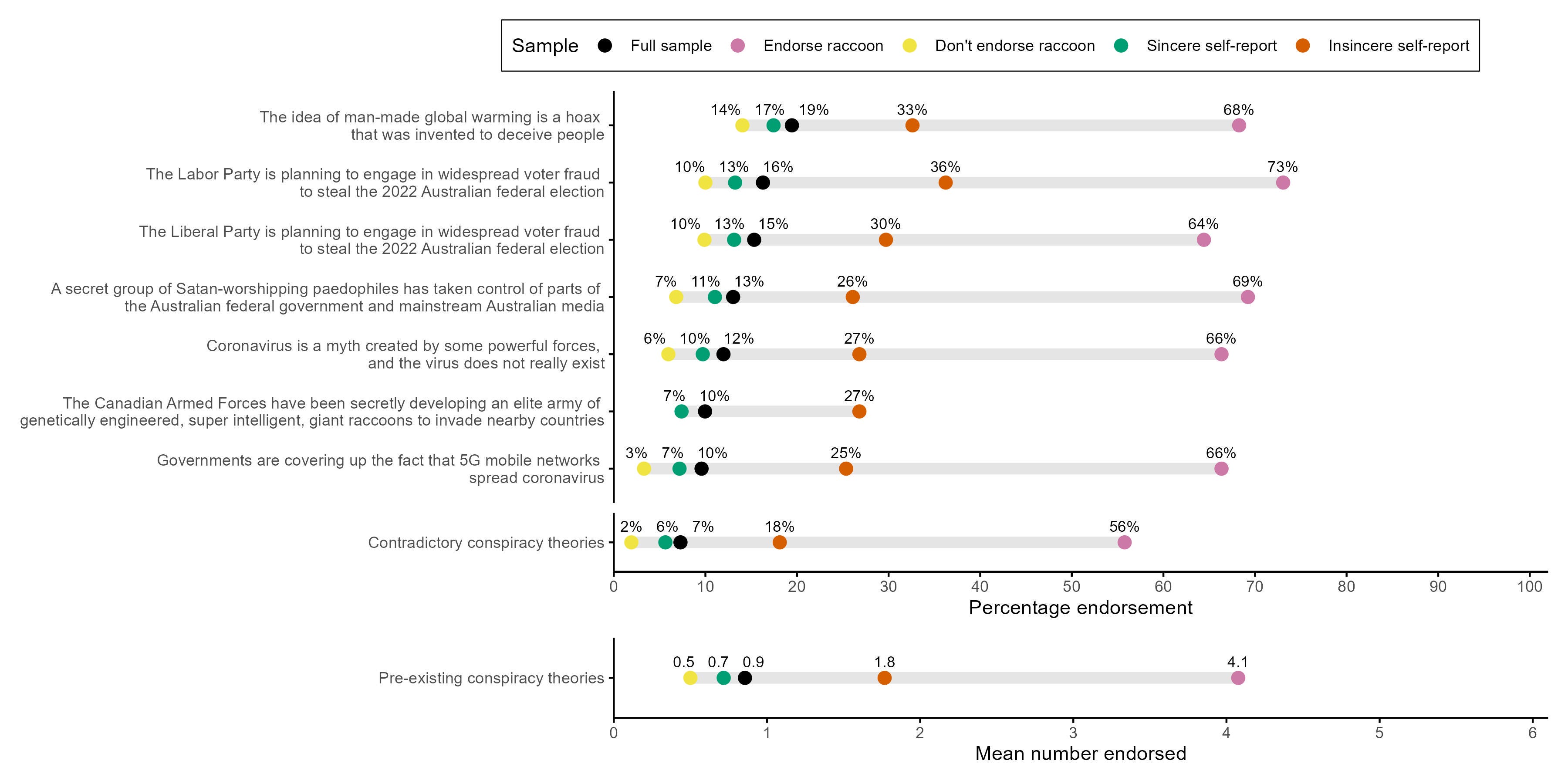
It shows that if you look across the survey at levels of conspiracy theory endorsement vary a lot by whether that person also endorses the specific raccoon army conspiracy theory. Although, we should note that even people who report responding sincerely endorse the raccoon army question at a rate of 7%.
§
People who work with polling and survey data will tell you that “everybody knows” that survey data can be unreliable. This might be one of those cases where “everybody” doesn’t include the media, or the media’s image of the public they imagine they are informing when they publish survey data.
In 2025 a YouGov poll in the UK found that 16% of 18-24 year olds reported being church goers, a massive increase over previous years which was termed a “quiet revival”. Now YouGov have admitted that flaws in their methodology mean the number is unreliable (I learnt this from More or Less yesterday).
The problem of unreliable reporting may be particularly exacerbated by hard-to-reach populations. Because survey companies want to represent the survey population they weight the answers they received by the expected proportions of each type of respondent. Concretely, this means that if they think 18-24 year olds are, say, 9% of the population, but only 1% of their survey are 18-24 years old, then they multiply each answer from a 18-24 year old by 9 to calculate their overall percentages.
Those aged 18-24 are exactly one of those hard to reach survey populations.
The clear lesson is that we should be doubly sceptical of surveys reporting findings for this demographic. A small number of careless or insincere respondents has more power to skew a headline percentage.
Alexander, and the Lizardman constant, are validated. Although it should perhaps now be the “raccon army” constant.
This newsletter is free for everyone to read and always will be. If you can afford it, feel free to chip in to help me keep writing for everyone: upgrade to a paid subscription (more on why here).
See below for references and other things I’ve noticed.
References
Ross, R. M., Ashton, L., Wilson, S., Gleeson, K., & Levy, N. (2026). Do people sincerely believe conspiracy theories that they endorse?. Collabra: Psychology, 12(1), 159253. https://doi.org/10.1525/collabra.159253
Original “lizardman constant post” from Scott Alexander. Lizardman’s Constant Is 4%
Jensen, T. (2013). Democrats and Republicans differ on conspiracy theory beliefs. https://www.publicpolicypolling.com/polls/democrats-and-republicans-differ-on-conspiracy-theory-beliefs/
Related, by me: The mythical median voter
rip.so
For all your online nostalgia needs
The internet moves fast. They were on our desktops one day, the next their servers were dark, their domains squatted, their icons gone from our trays. Some died of mismanagement, some of acquisition, some of irrelevance. Some are technically still alive, but their soul left a long time ago. This page is a memorial to all of them.
Reasoning in groups, with human and artificial agents

I have this talk in the Department of Computer Science and Technology at the University of Cambridge on Wednesday. It is a good summary of over 8 years of collaborative work on this topic, and there’s a recording here. Slides etc here https://tomstafford.github.io/talks.html
NY Times: “Book on Truth in the Age of A.I. Contains Quotes Made Up by A.I.”
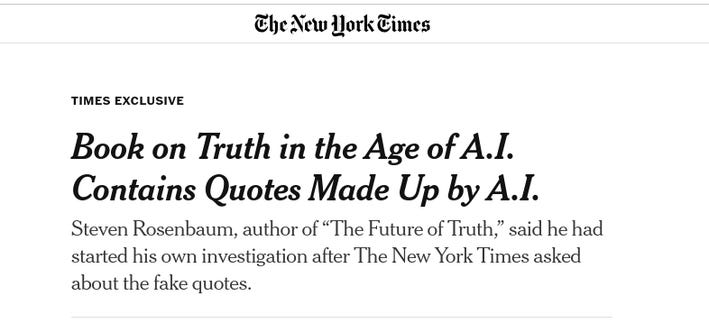
“As I disclosed in the book’s acknowledgments, I used A.I. tools ChatGPT and Claude during the research, writing and editing process,” Mr. Rosenbaum said in the statement.
And
“Mr. Rosenbaum’s book contains many quotes that are accurate, but the misattributed and invented quotes are scattered throughout.”
Ouch
NY Times 2026-05-19 (£) “Book on Truth in the Age of A.I. Contains Quotes Made Up by A.I.”
The Pac-Man Rule at Conferences
I like attempts to engineer new pro-social norms.
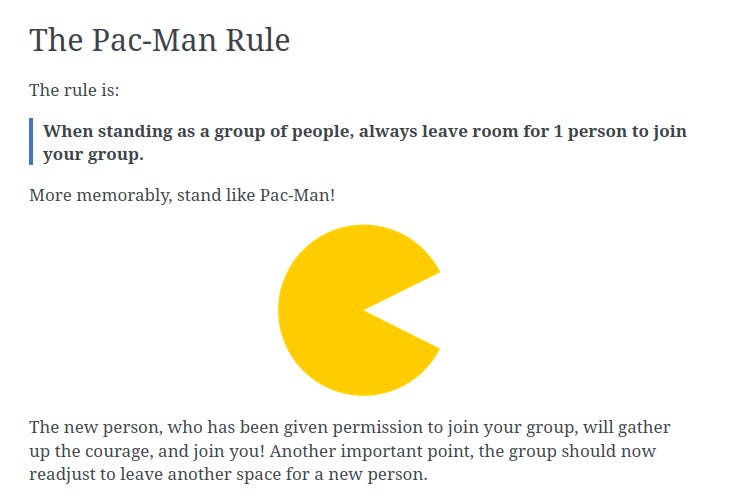
Eric Holscher, 2017-07-02 : The Pac-Man Rule at Conferences
Catch-up
Recent posts:
Confirmation bias in search. when technology panders to an existing weakness of human psychology
When trusted signals collapse. A case study in what can happen when AI levels the field
The 1,000 neuron challenge. A competition to design small, efficient neural models might provide new insight into real brains—and perhaps unite disparate modeling efforts.
The better algorithms of our nature. Engagement, bridging, and the design of digital platforms which don’t pander to our weaknesses.
The mythical median voter. Most people have an above average number of legs, and what that means for our political imagination
… And finally
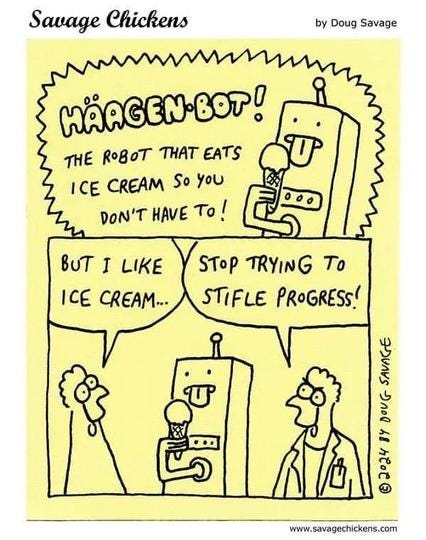
“The robot that eats ice cream so you don’t have to”
Comments? Feedback? Tips on how to defend against a racoon army? I am tom@idiolect.org.uk and on Mastodon at @tomstafford@mastodon.online
AI declaration: I write all the words and think all the thoughts myself. I asked Gemini to check for spelling and grammar.
From this we can deduce that some people who admitted responding insincerely didn’t say they believed in the racoon army - perhaps they felt they still had enough dignity not to stoop to that.
Journalists and editors focus on these suspect numbers because they point to importance and noteworthiness. They should stop doing this. This sticks in my mind: During the first Trump administration an editor asked me what real impact a fringe group would really have politics, because their numbers were relatively small. I should have responded: "These people will soon spearhead a riot at the U.S. Capitol".
Instead of focusing on the numbers, people should focus on the impact. A large number of Americans do think that the government is hiding evidence of extra-terrestrial life. Mostly this does not have much impact on daily life, although it might erode some trust in institutions. Other fringe beliefs and conspiracy theories have had profound impacts on society.
Excellente contextualisation! We have similar problems every year in France because of poorly designed annual surveys on conspiracy beliefs and critical thinking. Unfortunately...the "people are stupid" narrative sells too well and is too intuitive for most reports to question. I'm surprised you didn't link this article with your work on the "faith in reason" scale.