
Hostile interpolation
rhetorical style in the attention economy. Or, It's not you, but it's them

There’s a linguistic tic that large language models have. Once you notice it it becomes infuriating. “This isn’t destruction, it’s creation”, “This wasn’t smart, but dumb”, “not necessary, but pointless.”
There’s a great essay by Hollis Robbins about this, explaining that it is a product of the way language models represent knowledge, failing to ‘inherently compute’ the oppositeness relation of antonyms. The “not X, but Y” tic is the model externalising into language something it cannot do natively. I am not sure I buy this, but if it is true it is a remarkable example of language models using language the way we humans do - to capture and chain our thoughts - to build solid representations out of the fragmentary glimpses of what we can hold in mind at one time.
Regardless, the essay makes another note, that this construction operates on what linguists call the K-position (Heritage, 2012), construing knowledge — or lack of it — in the part of the listener1. In particular, it assigns them a status of presupposed ignorance, of believing X and needing to be corrected to understand Y. This, Robbins’ essay explains, is why the construction irks. If you aren’t ignorant, if you don’t hold the false belief, then you have to imaginatively enter into it to follow the text, only to then dismiss it. This imposes a cognitive cost, a little bump in the road of your being able to fluidly comprehend and enjoy the text.
I’d not heard of the K-position before I read Robbins’ essay, but I’d come across the fundamental idea, in the form of a more memorable phrase: hostile interpolation.
A friend had thrown out the phrase one night. I can’t remember the circumstance, although those two words expressed something so perfectly that the phrase burned itself in my brain. I hope we all know friends like this, someone more articulate, quicker, funnier than anyone you can see on stage or read on Substack. Despite his way with words, A. never wrote anything down, that I know, and the times I’ve searched the internet for the phrase “hostile interpolation” I’ve found nothing, so I can only presume it was A.’s own invention.
What he meant, what I took from it, was the way that a speech act can construe you in a position. The claim interpolates between the speaker and the one in the position of listening. That’s you; by listening you take on the position assumed by the speech act. By describing this interpolation as hostile, the phrase invites us to consider how speakers can address us in ways which are subtly, or not so subtly, demeaning or manipulative.
Advertisers, of course, are the all-time masters of hostile interpolation.
Here’s how Banksy put it :
People are taking the piss out of you everyday. They butt into your life, take a cheap shot at you and then disappear. They leer at you from tall buildings and make you feel small. They make flippant comments from buses that imply you’re not sexy enough and the fun is happening somewhere else. They are on TV making your girlfriend feel inadequate. They have access to the most sophisticated technology the world has ever seen and they bully you with it. They are The Advertisers and they are laughing at you.
Like the “not X but y” tic, once you’ve noticed this you see it everywhere. Fashion brands telling you that you’ll get left behind, technology brands telling you you’ll be left out, health brands inventing new things for you to worry about.

The technique is popular because it is so effective, and it is effective because you need a considerable amount of self confidence not to pause, even if just for a second, to ask if the claim might apply to you.
The positioning of hostile interpolation also infects a particular rhetorical style popular on short form social media. Dip into any platform and you’ll find the scolding admonishments to educate yourself, do better, and generally not make the mistakes people are obviously delighted to be observing so they can call them out. But correcting the ignorant so often constructs ignorance on the part of readers. A doltish, morally dubious, mass is summoned up as the imagined audience for these posts. The power of this trope is evidenced by the fact that it is so popular, despite positioning the people reading - the intended audience - as stupid and morally failing.
Here’s a benign example - not at all scolding - that I pulled from the feeds:
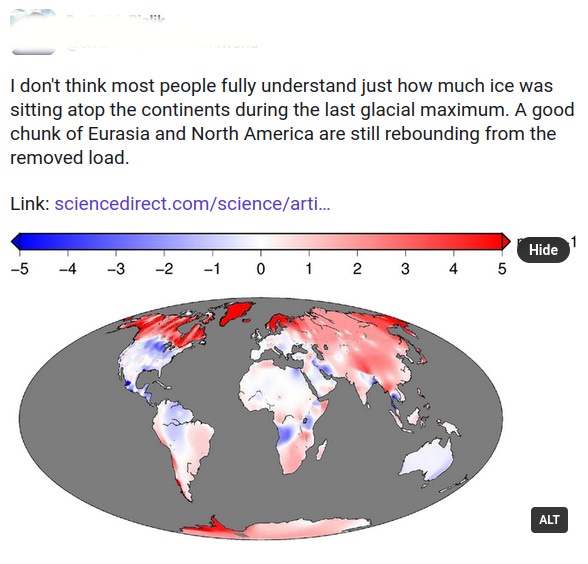
“I don't think most people fully understand just how much ice was sitting atop the continents during the last glacial maximum.”
It’s absurd because it interpolates us, the readers - and “most people” - as not fully understanding just how much ice was sitting atop the continents during the last glacial maximum. Be honest, before you read this, did you have any opinion about how much ice there was during the ice ages? The post summons into being a shadow you, one with both a belief about this, and false belief at that. You are then positioned as ready to be educated by the (admittedly informative) article linked to.2
The temperature in this style goes up as you cross into more moral domains.
Here’s a particular idiotic example a comment under the YouTube video for Bob Dylan’s “Ballad of Hollis Brown”:

“Just remember and never forget that Hollis Brown was a real person”
This is particular idiotic because Hollis Brown wasn’t a real person. Never mind if the person knew this and was just baiting readers, it reflects perfectly the style I’m talking about.
It raises the status of the writer - positioning them as aware of the wider moral universe and social struggles that the song speaks to - and instantaneously denigrates the rest of us. We thought we were just enjoying a tune from the premier song and dance man of the 1960s, now we’re in the position of people who forgot that Hollis Brown was a real person. Shame on us!
Scroll any social media and you’ll find plenty of hostile interpolation. I have the theory that this behaviour is driven because hacking status anxiety is an effective shortcut to get attention, and lots of social media is designed so that only shortcuts are possible.
The issue isn’t just that these constructions impose a cognitive cost. It is that they begin each discussion from a place where the reader is positioned as in the wrong. Even if you and I are not personally wrong, then we are surrounded by a mass of the ignorant and misled. This is terrible for our self image as a community of minds.
This newsletter is free for everyone to read and always will be. If you can afford it, feel free to chip in to help me keep writing for everyone: upgrading to a paid subscription (more on why here).
Below, references, further reading and other things I’ve been thinking about.
More:
Hollis Robbins: Metannoying. Your brain on “not X but Y”
Heritage, J. (2012). The epistemic engine: Sequence organization and territories of knowledge. Research on Language & Social Interaction, 45(1), 30-52. https://doi.org/10.1080/08351813.2012.646685
other things…
Jon Ronson on nonfiction storytelling
Jon Ronson has made all his posts from last year about nonfiction storytelling open - very useful. I was delighted to hear that he obsessively omits needless words
“I go over every paragraph, over and over, every day, maybe 100 times, tweaking this word, moving this comma, omitting every unnecessary word.”

Kevin Baker: AI got the blame for the Iran school bombing. The truth is far more worrying
Good piece on LLMs as “charismatic” technology which distract and confuse from engagement with the real causes.
In the days after the strike, the charisma of AI organised the entire political conversation around the technology: whether Claude hallucinated, whether the model was aligned, whether Anthropic bore responsibility for its deployment. The constitutional question of who authorised this war and the legal question of whether this strike constitutes a war crime were displaced by a technical question that is easier to ask and impossible to answer in the terms it set. The Claude debate absorbed the energy. That is what charisma does.
It has also occluded something deeper: the human decisions that led to the killing of between 175 and 180 people, most of them girls between the ages of seven and 12. Someone decided to compress the kill chain. Someone decided that deliberation was latency. Someone decided to build a system that produces 1,000 targeting decisions an hour and call them high-quality. Someone decided to start this war. Several hundred people are sitting on Capitol Hill, refusing to stop it. Calling it an “AI problem” gives those decisions, and those people, a place to hide.
The Guardian: AI got the blame for the Iran school bombing. The truth is far more worrying (2026-03-26)
Kevin Baker on substack: Artificial Bureaucracy
Catch up & Elsewhere
Something metascientific from me on the RoRI substack earlier this week:

And I’m very proud of last week’s post on here Quick facts on speed reading. Speed version here:
… And finally
END
Comments? Feedback? Scolding admonishment? I am tom@idiolect.org.uk and on Mastodon at @tomstafford@mastodon.online
For the avoidance of doubt, yes, those are em dashes. Em dashes I artisanally crafted and inserted by hand into this essay, without any language model assistance.
“Bayesian surface reconstruction of geodetic uplift rates: Mapping the global fingerprint of Glacial Isostatic Adjustment” https://doi.org/10.1016/j.jog.2018.10.002
Is it possible that this structure can be used for another potential purpose that's more focused on explaining the progression of the speaker's thought? Perhaps if I have realized something, I will then wish to convey the distinguishing point of that realization? I don't think this is the primary purpose of the structure in these examples and in advertising. I'm just considering how casual speech (especially face to face or between speakers who know each other) may use the same structure for slightly different reasons.
I think this structure or similar also makes sense in storytelling or poetry where the speaker is not manipulating the reader, but slowly revealing their experience. Which likely contains unknown information to the reader, so it's for the sake of suspense rather than to create a hierarchy.
In casual speech, could it also indicate a difference in style where the conclusion comes at the end rather than at the beginning of communication, building up to the point? Though when speaking in person, there is more context to warrant this structure. On social media, the speaker addresses an unknown listener. They could be specifically intending to talk to those who need to hear or would benefit from hearing this, but it also happens to be the case that the comment will be read by those who don't. I think it could also be for the sake of relatability rather than always intending to share information. I think there are more reasons to speak like this even on social media. Advertising, however, specializes in this hostile use of it.
Respectfully, because this _is_ a great post, might your friend have said "interpellation" instead of "interpolation"? [https://en.wikipedia.org/wiki/Interpellation_(philosophy)]